Enforcement of Foreign Arbitral Awards and Judgments in Russia After 2022
 The enforcement of foreign arbitral awards and court judgments in Russia has undergone significant transformation since 2022. While the formal legislative framework remains largely unchanged, judicial practice has evolved in response to geopolitical developments, sanctions regimes, and the designation of certain states as “unfriendly.”
These developments have affected the interpretation of public policy, reciprocity, and even the assessment of arbitral impartiality. The following overview examines the legal framework and the key trends that have emerged in Russian enforcement practice after 2022.
Legal Framework for Enforcement of Foreign Arbitral Awards and Judgements
Russia is a Party to the 1958 Convention on the Recognition and Enforcement of Foreign Arbitral Awards (the New York Convention), which obliges contracting states to recognise and enforce arbitral awards rendered in other contracting jurisdictions. Until 2022, Russian courts were generally regarded as arbitration-friendly, although they were known at times to interpret the concept of public policy broadly when refusing recognition and enforcement.
In addition, Russian law contains specific rules governing the enforcement of foreign court judgments. Under Article 241(1) of the Arbitrazh Procedure Code (APC), decisions of foreign courts in disputes arising out of commercial and other economic activities shall be recognised and enforced in Russia where such recognition is permitted by: (i) an international treaty to which the Russian Federation is a party; or (ii) a federal law of the Russian Federation.
In rare cases, in the absence of an applicable international treaty or federal law, Russian courts have recognised foreign court decisions on the basis of the principles of international comity and reciprocity.
Although this legal framework remains largely unchanged, the practice of courts has changed dramatically after February 2022.
Singling Out “Unfriendly Jurisdictions”
On 5 March 2022, the Government of the Russian Federation adopted Order No. 430-r approving a list of so-called “unfriendly” states—jurisdictions that have imposed or joined sanctions against Russia. This designation has had a visible impact on recognition and enforcement practice.
The list includes Australia, Albania, Andorra, the Bahamas, the United Kingdom (including Crown Dependencies and British Overseas Territories), Member States of the European Union, Iceland, Canada, Liechtenstein, Micronesia, Monaco, New Zealand, Norway, the Republic of Korea, San Marino, North Macedonia, Singapore, the United States, Taiwan (China), Ukraine, Montenegro, Switzerland, and Japan.
Other jurisdictions are regarded as “neutral,” which does not necessarily guarantee enforcement of judgements of arbitral awards, but the likelihood is higher, as discussed in more detail later.
Decisions on Recognition and Enforcement After 2022
Even before February 2022, Russian arbitrazh courts frequently relied on a broad interpretation of public policy to deny enforcement of arbitral awards. After February 2022, the prospects of enforcing arbitral awards and court judgments originating from “unfriendly” jurisdictions have declined further.
For example, in case No. А40-142624/2021, a Russian court refused to enforce an LCIA award. A key consideration was that the respondent was a strategic enterprise whose ultimate beneficiary was the Russian Federation. The court reasoned that enforcement of a foreign arbitral award in such circumstances could harm the Russian state budget by transferring funds to foreign companies.
In a more recent case (No. A14-13590/2022), a higher court set aside a lower court decision that had enforced an award of the International Commercial Arbitration Court (ICAC) at the Russian Chamber of Commerce and Industry in favour of a UK claimant. The court held that the lower court had failed to assess whether enforcement would contradict Russian public policy and whether it would violate temporary measures regulating the fulfilment of obligations to counterparties from “unfriendly” jurisdictions. Notably, the attempted enforcement concerned an award rendered in the Russian Federation under the rules of a Russian arbitral institution.
Earlier cases decided by Russian courts had already recognised economic restrictive measures as constituting force majeure (e.g., cases No. A41-90431/2019 and No. A56-45960/2020). Russian courts indicated that unavoidable circumstances may include foreign bans and restrictions affecting entrepreneurial activity, as well as other restrictive measures imposed on the Russian Federation, where such measures hinder contractual performance.
Enforcement of foreign court judgments (not only arbitral awards) has also been affected. For example, in one case (case No. A40-242631/2022), a Russian court refused to recognise and enforce a U.S. court judgment because the applicant had failed to demonstrate reciprocity and compliance with principles of international comity after February 2022. Reliance on earlier precedents was rejected on the ground that subsequent actions by the United States had been deemed unfriendly and contrary to international law.
At the same time, in rare cases arbitral awards and foreign court judgement originating from “unfriendly” jurisdictions are enforced in Russia, often when the creditor is a Russian party (see, e.g., case No А45-19015/2023 and case No А40-241039/2022).
Impartiality and the Presumption of Bias
Another notable development concerns the principles of equality and impartiality in arbitral and judicial proceedings.
Russian courts have increasingly clarified—and in some respects tightened—the standards applicable to impartiality. A key development was the Supreme Court’s decision in C. Thywissen GmbH v. Novosibirskkhleboprodukt (No. А45-19015/2023). The Court expressed doubts as to the objectivity and impartiality of arbitrators who are nationals of “unfriendly” states, effectively establishing a presumption of potential bias. In other words, the Supreme Court concluded that a lack of impartiality on the part of arbitrators from “unfriendly” jurisdictions may be presumed in certain circumstances, marking a significant doctrinal shift in Russian enforcement practice.
General Trends After February 2022
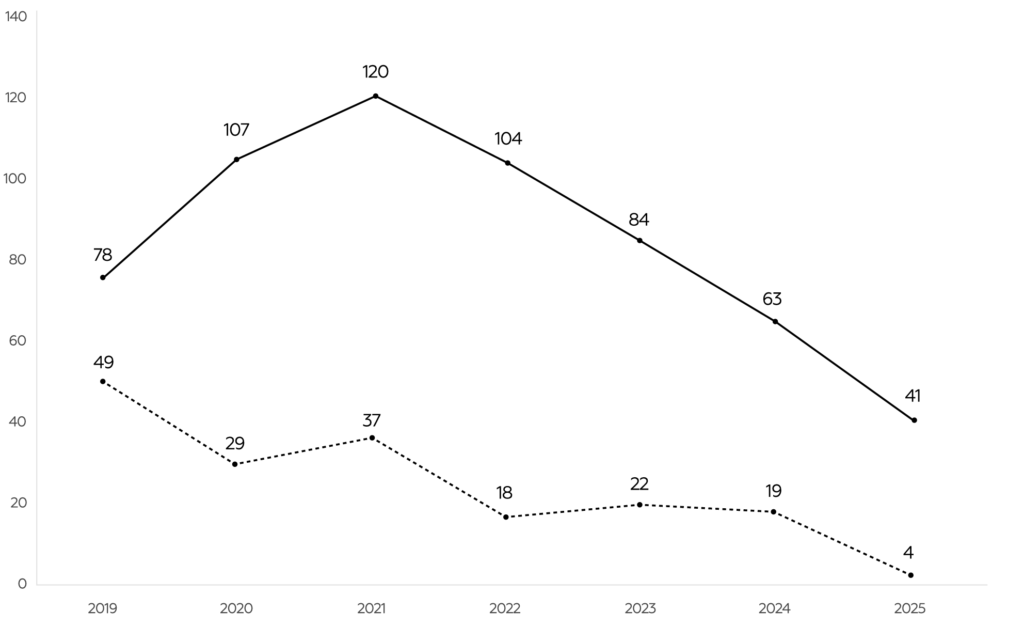
Number of cases on recognition and enforcement of foreign judgments and arbitral awards in Russia (2019–2025)
__________ litigation
———— arbitration
Source: KIAP study
A recent empirical study published by the Russian law firm KIAP (available only in Russian) indicates that the number of applications for recognition and enforcement of foreign arbitral awards and court judgments declined significantly after February 2022. In 2021, Russian courts considered 120 such cases; by 2025, that number had fallen to 41.
In 2025, of the 41 cases concerning foreign state court judgments, 93% involved “friendly” jurisdictions and only 7% concerned “unfriendly” jurisdictions. Most judgments for which recognition and enforcement were sought originated in the post-Soviet region. One of the institutions whose awards are most frequently recognised in Russia is the International Arbitration Court at the Belarusian Chamber of Commerce and Industry (BelCCI).
Judgments for which recognition was sought from “unfriendly” jurisdictions included Germany, Cyprus, Latvia, Poland, Ukraine, the United States, and Switzerland. Russian courts appear more willing to enforce arbitral awards administered by institutions registered in “unfriendly” states than to enforce judgments rendered by the state courts of those jurisdictions.
According to the study, in 2019–2025 the majority of foreign state court judgments and awards from “unfriendly” jurisdictions were not recognised or enforced in Russia. Importantly, when assessing enforcement applications, Russian courts have tended to focus on the place of registration of the administering arbitral institution rather than on the seat of arbitration.
Conclusion
Overall, since February 2022, the number of enforcement cases in Russian courts involving arbitral awards from “unfriendly” jurisdictions has fallen sharply, enforcement prospects have significantly deteriorated. Moreover, Russian courts have increasingly treated sanctions-related considerations as independent public policy grounds for refusal.
Although the statutory framework governing recognition and enforcement in Russia—particularly the New York Convention and the Arbitrazh Procedure Code—remains largely intact, judicial practice in Russia has evolved significantly since 2022. The expanded use of public policy and the practical impact of sanctions-related measures reflect a tightening of the enforcement landscape. Increased reliance on reciprocity considerations further reinforces this trend. In addition, the introduction of a presumption of potential bias concerning arbitrators from “unfriendly” jurisdictions signals a growing geopolitical dimension in enforcement decisions.

About the Author: Yarik Kryvoi
Professor Yarik Kryvoi, is the founder and co-editor of the CIS Arbitration Forum. He is the Senior Fellow in International Economic Law and Director of the Investment Treaty Forum at the British Institute of International and Comparative Law (BIICL). He holds law degrees from UCL, Harvard, Moscow and St Petersburg. Before moving to academia, he practiced law with Freshfields Bruckhaus Deringer in London, Morgan Lewis & Bockius in Washington, D.C. and Baker & McKenzie in St Petersburg. He often acts as a Russian Law expert in litigation and arbitration proceedings in the United Kingdom and other jurisdictions.Subscribe
If you enjoyed this article, subscribe to receive more just like it.